01 · The Origin A simple, brilliant idea.
Somewhere around the year 700, in the green, rain-soaked hills of Galicia, someone had a brilliant idea. Take something delicious. Wrap it in dough. Seal it shut.
It sounds simple — and it was. But that simple idea would travel farther than any empire, outlast every dynasty, and find its way into the hands and kitchens of nearly every culture on Earth.
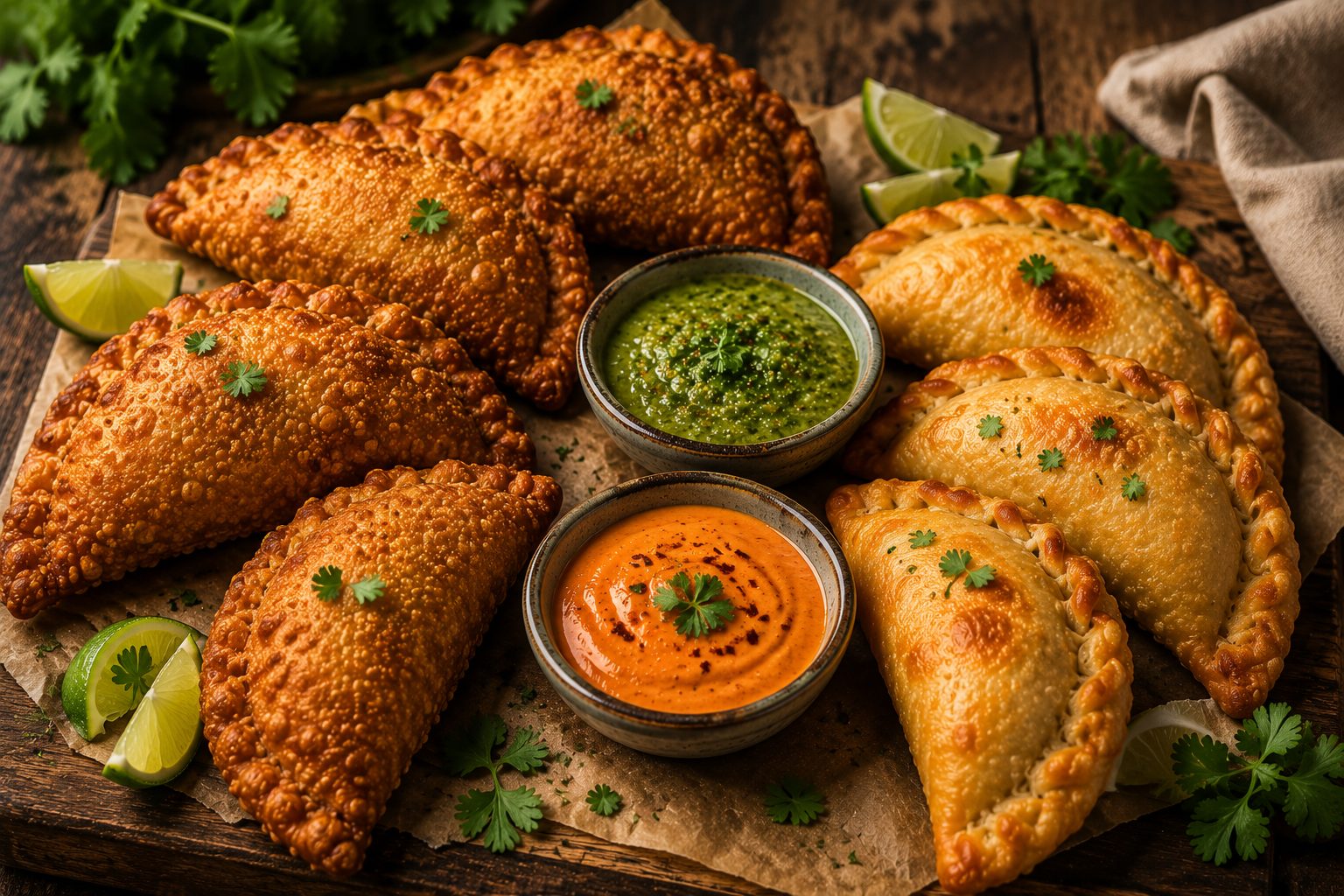
The word empanada comes from the Spanish empanar — “to wrap in bread.” That’s exactly what those early Galician cooks did. They took their best fillings — fresh-caught seafood, savory meats, vegetables kissed with olive oil — and enclosed them in a golden shell of hand-rolled dough. The result was more than food. It was a portable feast.
By the 12th century, empanadas were so beloved they were carved in stone at the Cathedral of Santiago de Compostela — alongside saints and angels.
Pilgrims walking the Camino de Santiago carried them as road food. Sailors packed them for long voyages. Farmers tucked them into pockets for the fields. Long before lunch boxes or takeout containers, the empanada was humanity’s original portable meal.
02 · Around the World Every culture made it their own.
When Spanish ships crossed the Atlantic in the 1500s, they carried empanadas with them. But everywhere the empanada landed, it transformed. Here’s the tour.
The original.
Big, round, baked in wood-fired ovens. Filled with fresh tuna or shellfish from the Atlantic. The kind of recipe that has been the same for thirteen hundred years.
A national obsession.
Every province has its own version, fiercely defended. In Tucumán, fried in beef fat with cumin and matambre. In Salta, small, spicy, juicy enough to burst. In Patagonia, lamb or seafood. Tucumán hosts the National Empanada Festival every year.
The Independence Day star.
The empanada de pino — beef, onion, olive, raisin, a hard-boiled egg inside like buried treasure. During Independence Day week, the country eats more than two hundred million of them.
Street-food royalty.
Wheat dough gave way to corn. Baking gave way to deep-frying. Crunch became the point. Squeeze of lime, dip in ají, eat from a cart while the city moves around you.
By way of the Manila Galleon.
Arrived by sea on one of history’s longest trade routes. In Ilocos, the dough became rice flour, tinted orange with annatto, filled with green papaya and local sausage. A texture you can’t find anywhere else.
The pastel.
Paper-thin. Shatteringly crisp. Bigger than your hand. Hearts of palm, guava paste, catupiry cheese — the showpiece of every open-air market.
Dressed in island heat.
The Cornish pasty met African spice tradition and became the beef patty — golden from turmeric, fiery from Scotch bonnet, flaky beyond belief.
The whole spectrum.
We draw from this global tapestry — the craftsmanship of Argentina, the boldness of Colombia, the warmth of Spain, the creativity of every kitchen that ever wrapped something delicious in dough. And we add something you won’t find anywhere else: a rainbow. Every Born Chef empanada wears its flavor on the outside.
03 · The Signature Color is our code.
Traditionally, empanada makers developed an ingenious system called the repulgue — a hand-crimped edge where different folding patterns told you what was inside before you took a single bite. It was an edible language, passed from generation to generation.
We honor that spirit — but we wrote our own dialect.
Born Chef uses color-coded dough. Each flavor gets its own vibrant hue. You can tell what’s inside before you take a single bite, just by looking. A tray of Born Chef empanadas isn’t just a meal — it’s a mosaic. A spectrum. A feast for the eyes before it ever hits your taste buds.